A cochlear implant is not automatically better than a hearing aid. Hearing aids are generally used when the inner ear can still respond adequately to amplified sound, while a cochlear implant in Jayanagar may be considered when severe-to-profound sensorineural hearing loss limits the benefit a person receives from appropriately fitted hearing aids. Neither device is universally “better” — the right choice depends on the individual’s degree and type of hearing loss, speech understanding, response to hearing aids, age, general health, and communication needs. Determining candidacy requires a comprehensive hearing and ENT assessment, which is why adults and families in Jayanagar and Bengaluru exploring this decision are encouraged to start with a professional evaluation rather than relying on the hearing-loss number alone.
Cochlear Implant vs Hearing Aid: What Is the Difference?
In short, a hearing aid amplifies sound so that a functioning inner ear can process it more easily, while a cochlear implant bypasses damaged sensory hair cells in the cochlea and electrically stimulates the auditory nerve directly. This is the core of the cochlear implant vs hearing aid distinction: one device makes sound louder, and the other creates a different pathway for sound signals to reach the brain.
Because hearing aids work by amplifying existing residual hearing, they do not require surgery. A cochlear implant, on the other hand, involves surgically placing an internal component beneath the skin and within the cochlea, which is why it requires a surgical procedure and a period of recovery, activation, and rehabilitation afterward.
| Feature | Hearing Aid | Cochlear Implant |
| Main function | Amplifies sound | Converts sound into electrical signals |
| Surgery required | No | Yes |
| Typical use | Mild to severe hearing loss, depending on individual factors | Severe to profound sensorineural hearing loss in appropriate candidates |
| Natural hearing structures | Relies on functioning inner-ear pathways | Bypasses damaged cochlear sensory cells |
| Assessment | Hearing evaluation and fitting | Comprehensive cochlear implant candidacy assessment |
| Rehabilitation | Hearing-aid adaptation | Often requires auditory rehabilitation after activation |
What Is a Hearing Aid?
A hearing aid is an electronic device worn in or behind the ear that picks up sound, amplifies it, and delivers it into the ear canal. Hearing aids are commonly recommended for adults with mild, moderate, or in some cases severe hearing loss, depending on how well their inner ear still responds to amplified sound.
Proper hearing-aid fitting and programming are essential — a device that is not correctly fitted or adjusted to an individual’s hearing profile may not provide adequate benefit even if it is technically the right type of device. After fitting, some patients also benefit from a period of hearing-aid adaptation, sometimes called auditory rehabilitation, to adjust to processed sound.
It’s important to note that hearing aids do not work equally well for everyone. In some people with severe or profound sensorineural hearing loss, even well-fitted hearing aids may not provide sufficient speech understanding, particularly in noisy environments. This does not mean hearing aids are ineffective in general — only that their benefit varies with the degree and type of hearing loss present.
What Is a Cochlear Implant?
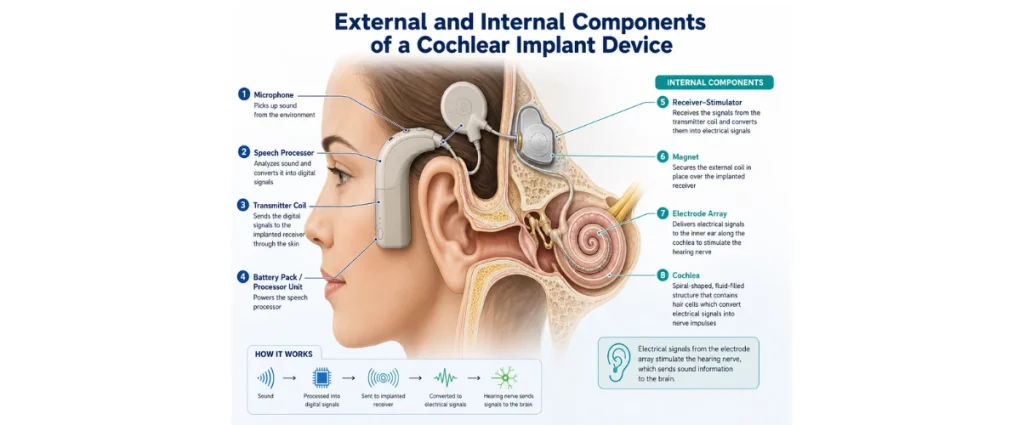
A cochlear implant is a surgically placed hearing device made up of two main parts: an external sound processor worn behind the ear, and an internal component placed under the skin with an electrode array inserted into the cochlea.
The external processor captures sound and converts it into a digital signal, which is transmitted through the skin to the internal implant. The implant then converts this signal into electrical impulses that directly stimulate the auditory nerve, bypassing the damaged hair cells that would normally perform this function in a healthy cochlea. This is fundamentally different from a hearing aid, which relies on those same hair cells still being functional enough to process amplified sound.
Because the internal component must be surgically positioned within the cochlea, cochlear implantation involves a surgical procedure under anesthesia. After surgery and a period of healing, the device is switched on (activation), and its settings are gradually adjusted (mapping) over subsequent visits. Auditory rehabilitation — learning to interpret the new pattern of electrical stimulation as meaningful sound — is an important part of the process for most recipients.
Who Needs a Cochlear Implant?
Who needs a cochlear implant is a common question, and the answer depends on a combination of clinical findings rather than hearing-loss severity alone. Candidacy may be considered for individuals who have:
- Severe-to-profound sensorineural hearing loss
- Limited benefit from appropriately fitted hearing aids
- Poor speech recognition despite adequate amplification
- Hearing loss that is significantly affecting communication and daily life
- Auditory nerve and inner-ear anatomy suitable for implantation
- General medical suitability for a surgical procedure
Candidacy criteria can vary based on age, hearing test results, speech recognition scores, communication needs, and individual clinical protocols. Because of this, only an ENT specialist working with a cochlear implant team can determine whether a specific person is an appropriate candidate — self-assessment based on hearing-loss severity alone is not sufficient.
Cochlear Implant for Adults
Cochlear implant for adults is often considered in cases of progressive severe or profound hearing loss, including in adults who previously used hearing aids but are experiencing declining speech understanding over time. This is a common pathway: a person manages well with hearing aids for years, then notices that even well-adjusted devices no longer help them follow conversation clearly.
Evaluation for adults typically includes:
- A detailed hearing-aid benefit assessment
- Pure-tone and speech-recognition testing
- Imaging studies when clinically indicated
- General medical assessment for surgical fitness
- Discussion of expectations and the rehabilitation process
Adults who meet appropriate candidacy criteria can benefit from cochlear implantation, but outcomes vary from person to person depending on factors such as duration of hearing loss, auditory nerve function, and commitment to post-implant rehabilitation.
Cochlear Implant for Children
Cochlear implant for children involves a different set of considerations centered on speech and language development. Early identification of significant hearing loss — often through newborn hearing screening — allows timely evaluation and intervention, which can be important during the critical early years of language development.
Hearing aids remain an important part of management for many children with hearing loss and are often tried first when appropriate. Cochlear implantation may be considered for children with severe-to-profound hearing loss who do not receive sufficient benefit from hearing aids, based on individualized assessment by a pediatric ENT and audiology team.
Children being evaluated for cochlear implants typically require:
- Comprehensive audiological testing
- Medical and imaging evaluation
- Family counselling and involvement in decision-making
- A plan for speech-language therapy or auditory-verbal rehabilitation
- Long-term follow-up as the child grows
Every child’s situation is different, and decisions should be individualized rather than based on a general assumption that implantation is right for all children with hearing loss.
Severe Hearing Loss Treatment: What Are the Options?
Severe hearing loss treatment is not one-size-fits-all. The right approach depends on the type of hearing loss, degree of loss, whether one or both ears are affected, the underlying cause, speech recognition ability, hearing-aid benefit, age, and overall communication needs.
Depending on these factors, management may include:
- Well-fitted and properly programmed hearing aids
- Assistive listening devices to supplement hearing aids in specific situations
- Treatment of reversible causes, where applicable, after appropriate diagnosis
- Cochlear implantation for individuals who meet candidacy criteria
- Structured auditory rehabilitation
- Regular hearing monitoring to track changes over time
A thorough hearing and ENT evaluation is the starting point for determining which of these options — or which combination — is appropriate for a given individual.
What Happens During Cochlear Implant Surgery?
Patients considering cochlear implant surgery Bangalore or elsewhere often want to understand the general process before proceeding. At a high level, it typically involves:
- Preoperative hearing and speech testing
- General medical assessment to confirm surgical fitness
- Imaging studies where required
- Surgical implantation of the internal device under anesthesia
- A period of recovery and wound healing
- Device activation once healing is adequate
- Programming and adjustment of the sound processor (mapping)
- Ongoing auditory rehabilitation and follow-up visits
This is a general overview rather than detailed surgical instruction, and the exact process can vary based on individual clinical circumstances.
Cochlear Implant vs Hearing Aid: Which One Is Better?
There is no single answer that applies to everyone, but some general patterns can help guide understanding.
Hearing aids may be appropriate when:
- The person receives clear, useful benefit from amplification
- Speech understanding improves adequately with hearing aids, including in everyday listening situations
- The degree of hearing loss falls within a range where hearing aids typically provide sufficient benefit
- There are no specific clinical indications pointing toward implantation
A cochlear implant may be considered when:
- Hearing loss is severe or profound
- Properly fitted hearing aids provide limited real-world benefit
- Speech understanding remains poor despite optimized amplification
- The individual meets established clinical candidacy criteria after full evaluation
The decision should be based on hearing evaluation and cochlear implant candidacy testing, not simply the severity of the hearing-loss number. Two people with a similar audiogram can have very different outcomes with hearing aids, which is exactly why individualized testing matters more than a single hearing-loss figure.
Factors That Determine Cochlear Implant Candidacy
A comprehensive evaluation typically considers:
- Pure-tone audiometry results
- Speech recognition scores, with and without hearing aids
- A documented hearing-aid trial and the benefit obtained from it
- Type and severity of hearing loss
- Duration of hearing loss
- Age at evaluation
- Communication needs and lifestyle
- Relevant medical history
- Imaging and anatomical considerations, including auditory nerve function
- Patient and family expectations
- Willingness and ability to commit to post-implant rehabilitation
A complete evaluation across these factors is necessary because no single test can determine candidacy on its own.
Potential Benefits of Cochlear Implants
For individuals who meet candidacy criteria, cochlear implants may improve:
- Awareness of environmental sounds
- Speech perception, particularly in structured listening situations
- Overall communication ability
- Confidence in everyday listening tasks
Many suitable candidates experience meaningful improvement in their ability to communicate, though the degree of benefit varies from person to person and cannot be guaranteed in advance.
Limitations and Considerations
Cochlear implants also come with important limitations to consider:
- The procedure requires surgery and the associated recovery period
- Results vary between individuals and cannot be predicted with certainty
- Auditory rehabilitation is often necessary to gain full benefit
- The device requires ongoing maintenance, programming visits, and follow-up
- Sound through a cochlear implant can initially feel different from natural hearing and takes adjustment
- Not everyone with severe hearing loss is a suitable candidate
- No hearing outcome can be guaranteed
A balanced understanding of both benefits and limitations supports realistic expectations and informed decision-making.
When Should You See an ENT Specialist?
Consider a medical evaluation if you or a family member experiences:
- Persistent hearing difficulty
- Progressive hearing loss over time
- Difficulty understanding speech despite using hearing aids
- Severe or profound hearing loss
- Ringing in the ears accompanying hearing changes
- Recurrent ear infections
- Sudden changes in hearing
- Ongoing difficulty communicating in noisy environments
Sudden hearing loss, severe ear pain, bleeding from the ear, or significant dizziness requires prompt medical assessment and should not be evaluated through self-diagnosis or delayed in the hope that it resolves on its own.
The Role of an ENT and Cochlear Implant Specialist
Patients exploring whether hearing aids or a cochlear implant may be appropriate often benefit from evaluation by an experienced ENT team with specific experience in cochlear implantation. Dr. Rohit Udaya Prasad, at Dr Rohit’s Centre for ENT & Cochlear Implant, provides ENT and hearing evaluation services, including assessment related to cochlear implant candidacy, for patients in Jayanagar and the wider Bengaluru area.
A proper evaluation by a cochlear implant specialist in Jayanagar can help determine whether hearing aids, cochlear implantation, or another hearing-care approach is the most suitable path forward for a specific individual — this determination should always follow clinical assessment rather than personal assumption.
Seeking Care in Jayanagar and Bengaluru
Adults and families in 7th Block, Jayanagar, Bengaluru, Karnataka, dealing with severe hearing loss can seek ENT and hearing evaluation locally rather than relying solely on general online information. A cochlear implant in Jayanagar evaluation typically begins with detailed hearing testing and a review of hearing-aid history before any discussion of surgical options takes place. For patients considering cochlear implant surgery Bangalore-wide, focusing on thorough diagnostic evaluation and follow-up care matters more than the specific location chosen for treatment.
Conclusion
Hearing aids and cochlear implants serve different purposes within hearing care. Hearing aids amplify sound for ears that can still make use of it, while cochlear implants provide electrical stimulation directly to the auditory nerve for individuals whose severe-to-profound hearing loss limits the benefit they receive from amplification alone. Because candidacy must be assessed individually — considering hearing test results, speech recognition, hearing-aid history, and overall health — a professional ENT and hearing evaluation is the essential first step before deciding between the two.
If you or a family member is dealing with severe hearing loss, declining benefit from hearing aids, or ongoing difficulty following conversation, consider scheduling a cochlear implant in Jayanagar evaluation with Dr. Rohit Udaya Prasad at Dr Rohit’s Centre for ENT & Cochlear Implant in 7th Block, Jayanagar, Bengaluru. A thorough assessment can help clarify whether hearing aids, cochlear implantation, or another approach is the right fit for your specific hearing needs — with no assumptions and no guaranteed outcomes, only an individualized clinical opinion.
Frequently Asked Questions
- Is a cochlear implant better than a hearing aid for severe hearing loss?
Not automatically. Hearing aids work well when the inner ear can still process amplified sound, while cochlear implants may help when hearing aids no longer provide adequate speech understanding. The better option depends on individual hearing test results and candidacy evaluation. - Who needs a cochlear implant instead of a hearing aid?
Individuals with severe-to-profound sensorineural hearing loss who receive limited benefit from properly fitted hearing aids may be considered for cochlear implantation. Suitability is confirmed through comprehensive audiological and medical evaluation, not by hearing-loss severity alone. - Can adults with severe hearing loss get a cochlear implant?
Yes, adults with severe-to-profound hearing loss — including those with declining benefit from long-term hearing-aid use — may be evaluated for a cochlear implant for adults. Candidacy depends on hearing tests, speech recognition scores, and overall medical suitability. - Can children with severe hearing loss receive cochlear implants?
Yes, in appropriate cases. A cochlear implant for children may be considered when hearing aids do not provide sufficient benefit for severe-to-profound hearing loss, following comprehensive pediatric audiological and medical assessment involving the family. - How does a cochlear implant differ from a hearing aid?
A hearing aid amplifies sound for the ear to process naturally, while a cochlear implant bypasses damaged inner-ear cells and electrically stimulates the auditory nerve directly. This is the key distinction in the cochlear implant vs hearing aid comparison. - How do I know if I am a cochlear implant candidate?
Candidacy is determined through hearing tests, speech recognition assessment, a documented hearing-aid trial, and medical evaluation — not by hearing-loss severity alone. Only an ENT and cochlear implant team can confirm whether you meet the clinical criteria. - Does cochlear implant surgery require hospitalization?
Cochlear implant surgery is typically performed under anesthesia and may involve a short hospital stay, depending on individual circumstances and the treating surgical team’s protocol. Your ENT specialist can explain the specific plan during evaluation. - How long does it take to hear after cochlear implant surgery?
The device is usually activated a few weeks after surgery, once healing is adequate. Sound perception develops gradually through programming (mapping) sessions and auditory rehabilitation, and the pace of improvement varies between individuals. - Is cochlear implant surgery suitable for everyone with severe hearing loss?
No. Cochlear implants are appropriate only for individuals who meet specific audiological and medical candidacy criteria. Some people with severe hearing loss continue to benefit adequately from hearing aids and do not require surgical intervention. - Where can I consult a cochlear implant specialist in Jayanagar?
Patients in Bengaluru can consult a cochlear implant specialist in Jayanagar, such as Dr. Rohit Udaya Prasad at Dr Rohit’s Centre for ENT & Cochlear Implant in 7th Block, Jayanagar, for hearing evaluation and cochlear implant candidacy assessment.