+(01) 1987 123456
12th street, LA
Reach out to our ENT specialists for expert care in hearing, breathing, and voice-related concerns.
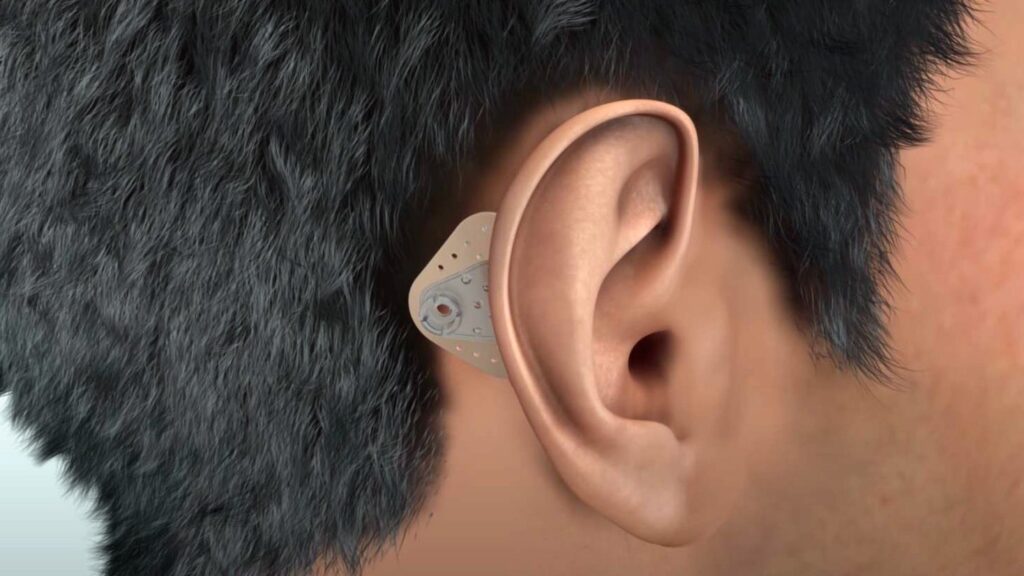
Adhear and BAHA (Bone Anchored Hearing Aids) are advanced hearing solutions designed for individuals who cannot use conventional hearing aids due to ear canal problems, chronic infections, or congenital conditions. Instead of transmitting sound through the ear canal, these devices use bone conduction technology to send vibrations directly to the inner ear (cochlea), bypassing the outer and middle ear. This provides clear, natural sound without discomfort or interference from damaged ear structures.
Both Adhear and BAHA systems rely on the principle of bone conduction:
Adhear: A non-surgical, adhesive-based device worn behind the ear. It picks up sound and transfers vibrations through the skin and bone to the cochlea.
BAHA (Bone Anchored Hearing Aid): A surgically implanted titanium fixture placed in the skull bone behind the ear. An external processor connects to the implant and transmits sound vibrations directly to the inner ear.
These approaches allow individuals with outer or middle ear problems to hear effectively without relying on the ear canal.
These devices are ideal for patients who:
Have conductive or mixed hearing loss due to outer or middle ear problems.
Suffer from chronic ear infections that prevent the use of traditional hearing aids.
Have congenital ear malformations such as atresia or microtia.
Experience single-sided deafness (SSD), where sound from the deaf side is transmitted to the functioning cochlea of the opposite ear.
Seek a comfortable and effective alternative to conventional hearing aids.
Bypasses Blockages: Effective for patients with ear canal or middle ear issues.
Clear Sound Quality: Direct bone transmission reduces distortion.
Comfortable Use: Adhear is non-invasive and adhesive-based, while BAHA is lightweight and discreet.
Reliable Long-Term Solution: Especially effective for chronic ear problems.
Improved Directional Hearing: Helps patients localize sounds better, particularly in single-sided deafness.
Tailored Options: Non-surgical (Adhear) or surgical (BAHA) depending on patient preference and medical needs.
Adhear: Non-surgical and ready to use immediately. The processor attaches with an adhesive adapter behind the ear, making it quick and painless.
BAHA: Requires a minor surgical procedure under local or general anesthesia to place the titanium implant in the skull bone. After healing (usually 2–3 months), the sound processor is fitted and activated. Patients experience immediate improvement in hearing once the device is turned on.
Adhear and BAHA represent innovative solutions for individuals who cannot benefit from conventional hearing aids. By transmitting sound directly to the inner ear, these devices provide clear, natural hearing while avoiding complications associated with ear canal or middle ear problems. With options for both surgical and non-surgical solutions, patients can choose the method that best suits their lifestyle and medical condition. These devices restore hearing, improve communication, and significantly enhance quality of life.
Adhear and BAHA (Bone Anchored Hearing Aid) are two related bone conduction solutions that give patients options beyond a fully surgical implant — Adhear is a non-surgical, adhesive-based device, while BAHA involves a small titanium implant anchored to the skull. Both work by transmitting sound vibrations through bone to a functioning inner ear, making them useful for conductive hearing loss, chronic ear infections, or single-sided deafness. At Dr Rohit’s Centre for ENT & Cochlear Implant in Jayanagar, Bangalore, we help patients understand which option — trial-friendly Adhear or the more permanent BAHA — best matches their hearing needs and lifestyle.
Adhear is a non-surgical, adhesive bone conduction hearing device that attaches behind the ear without an implant, making it suitable for patients who want to avoid surgery or try bone conduction hearing first. BAHA (Bone Anchored Hearing Aid) is a surgically implanted hearing system that uses a small titanium implant anchored in the skull bone for a long-term solution.
Both devices are suitable for people with conductive or mixed hearing loss, chronic ear infections, congenital ear canal abnormalities, or single-sided deafness. A comprehensive ENT and hearing evaluation helps determine whether a non-surgical Adhear device or a surgically implanted BAHA is the better option.
Yes. One of the main advantages of Adhear is that it can be trialed without surgery. This allows patients to experience the benefits of bone conduction hearing before deciding whether to proceed with a permanent implanted solution such as BAHA.
No. BAHA surgery is a well-established, minimally invasive procedure that places a small titanium implant into the skull bone. It is usually performed under local or general anesthesia, depending on the patient's age and individual needs, and typically involves a relatively quick recovery.
Adhear is a non-surgical bone conduction hearing device that attaches to the skin behind the ear using a special adhesive adapter. It delivers sound vibrations directly to the inner ear without requiring an implant or incision, making it an excellent option for selected patients and hearing trials.
BAHA stands for Bone Anchored Hearing Aid. It uses a small titanium implant placed in the skull bone to support an external sound processor, which transmits sound vibrations directly to the inner ear while bypassing damaged outer or middle ear structures.
Yes. Adhear is often recommended for younger children because it requires no surgery. BAHA implantation may be considered later, once the child meets the required age, bone development, and medical suitability criteria determined by an ENT specialist.
Not necessarily. BAHA is designed for people with conductive or mixed hearing loss, chronic ear disease, congenital ear canal abnormalities, or single-sided deafness. Conventional hearing aids remain the preferred option for many other types of hearing loss. An ENT specialist can recommend the most suitable device based on your hearing evaluation.