+(01) 1987 123456
12th street, LA
Reach out to our ENT specialists for expert care in hearing, breathing, and voice-related concerns.
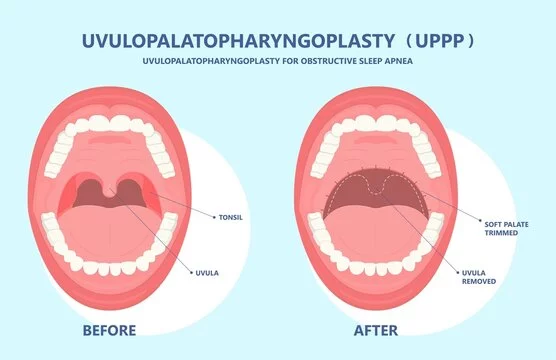
Uvulopalatopharyngoplasty (UPPP) is a surgical procedure performed to treat obstructive sleep apnea (OSA) and chronic snoring. The surgery involves removing or reshaping excess tissue from the throat, including the uvula, part of the soft palate, and sometimes the tonsils, to widen the airway and improve airflow during sleep. By reducing airway obstruction, UPPP helps restore normal breathing, reduce snoring, and improve sleep quality.
This procedure may be recommended for patients who:
Have moderate to severe OSA not responding to CPAP or oral devices.
Suffer from chronic, loud snoring affecting daily life or relationships.
Have structural blockages in the throat contributing to airway collapse.
Are unable to tolerate CPAP therapy due to discomfort or compliance issues.
Loud, persistent snoring.
Pauses in breathing during sleep.
Daytime fatigue and poor concentration.
Morning headaches and dry mouth.
Restless or non-refreshing sleep.
During the procedure:
The patient is placed under general anesthesia.
The surgeon removes or reshapes the uvula, soft palate, and other obstructing tissues.
Tonsils and adenoids may also be removed if they contribute to the blockage.
The goal is to create a wider, more stable airway that resists collapse during sleep.
Adults with OSA caused by excess throat tissue.
Patients unable to tolerate or benefit from CPAP therapy.
Individuals with chronic snoring unresponsive to lifestyle changes.
Patients with anatomical narrowing of the throat contributing to sleep apnea.
Improves Airflow: Widens the airway for better breathing during sleep.
Reduces Snoring: Provides long-term relief from chronic snoring.
Treats Sleep Apnea: Reduces apneic episodes and improves oxygenation.
Enhances Sleep Quality: Improves restfulness, energy, and concentration.
Prevents Health Risks: Lowers the chances of OSA-related complications such as hypertension and heart disease.
UPPP is typically performed in a hospital setting and takes 1–2 hours. Most patients stay overnight for observation. Recovery may involve a sore throat, difficulty swallowing, or mild voice changes for a few weeks. Pain medications, hydration, and a soft diet aid healing. Patients usually return to normal activities in 1–2 weeks, with significant improvements in sleep quality over time.
Uvulopalatopharyngoplasty offers an effective surgical solution for patients struggling with obstructive sleep apnea and chronic snoring. With advanced techniques, it improves airway stability, restores restful sleep, and reduces long-term health risks. For those who cannot tolerate CPAP or continue to suffer despite non-surgical treatments, UPPP provides a safe, proven, and lasting solution.
If loud snoring or breathing pauses during sleep are affecting your health and relationships, Uvulopalatopharyngoplasty (UPPP) may offer lasting relief. At Dr Rohit’s Centre for ENT & Cochlear Implant in Jayanagar, Bangalore, our ENT surgeons use UPPP to reshape the soft palate, uvula, and throat tissue that narrow your airway during sleep. This procedure is recommended for patients with obstructive sleep apnea who cannot tolerate CPAP or haven’t found relief from lifestyle changes. Serving patients across Jayanagar, JP Nagar, and greater Bangalore, our team combines detailed airway assessment with precise surgical technique to help you breathe — and sleep — better.
Uvulopalatopharyngoplasty in Bangalore at Dr Rohit’s Centre For ENT & Cochlear Implant offers advanced surgical treatment for snoring and obstructive sleep apnea. Our expert ENT specialists use modern techniques to remove excess throat tissue, improving breathing and sleep quality. Experience safe, effective, and personalized care for better airway health and restful sleep.
UPPP surgery significantly reduces snoring and airway obstruction in many patients by removing excess throat tissue. Results vary depending on body weight, age, and airway anatomy. Many patients experience long-term improvement, although some may still benefit from additional treatment such as CPAP therapy.
The cost of UPPP surgery in Bangalore depends on factors such as the hospital, anesthesia, room category, and whether procedures like tonsillectomy are performed along with UPPP. Following a detailed airway evaluation, your ENT surgeon will provide a personalized treatment plan and cost estimate.
Most patients return to normal daily activities within 1 to 2 weeks. Mild throat pain and difficulty swallowing are common during the initial recovery period and usually improve with medications, hydration, and a soft diet.
UPPP may not be suitable for patients with severe obesity-related airway collapse, certain neuromuscular disorders, or sleep apnea caused by factors outside the throat. In such cases, treatments like CPAP therapy or jaw advancement surgery may be more appropriate.
Uvulopalatopharyngoplasty (UPPP) is a surgical procedure that removes or reshapes excess tissue from the uvula, soft palate, and surrounding throat structures to widen the airway. It is commonly recommended for patients with chronic snoring or obstructive sleep apnea when CPAP therapy or lifestyle changes are not effective.
Dr. Rohit's Centre for ENT & Cochlear Implant, located in 7th Block, Jayanagar, offers advanced UPPP surgery and other snoring treatments for patients from Jayanagar, JP Nagar, and across Bangalore. A consultation includes a comprehensive airway evaluation before recommending surgery.
UPPP surgery is performed under general anesthesia, so you will not experience pain during the procedure. After surgery, a sore throat and mild discomfort while swallowing for one to two weeks are normal and can be effectively managed with prescribed medications.
Neither option is universally better. CPAP is a non-surgical treatment that keeps the airway open using positive air pressure, whereas UPPP surgery addresses structural airway blockages through surgery. Your ENT specialist will recommend the most suitable option based on your sleep study results, airway anatomy, and ability to tolerate CPAP.