+(01) 1987 123456
12th street, LA
Reach out to our ENT specialists for expert care in hearing, breathing, and voice-related concerns.
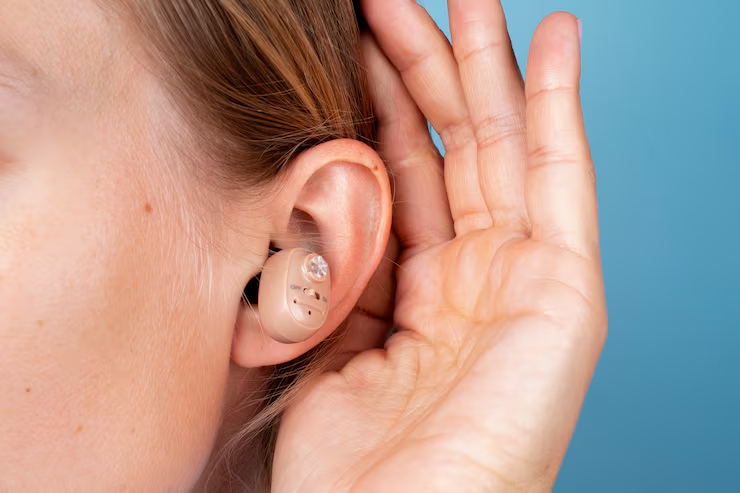
Hearing implants are advanced medical devices designed for individuals with significant hearing loss who do not benefit from conventional hearing aids. Unlike traditional devices that amplify sound, hearing implants directly stimulate the hearing pathway, providing clearer, more natural sound perception. They play a crucial role in restoring hearing, improving communication, and enhancing quality of life for both children and adults.
Different types of implants are recommended depending on the cause and severity of hearing loss:
Cochlear Implants: Bypass damaged parts of the inner ear and directly stimulate the auditory nerve.
Bone Conduction Implants (BCI/BAHA/Adhear): Transmit sound vibrations through the skull bone to the inner ear, bypassing the outer and middle ear.
Middle Ear Implants: Directly stimulate middle ear structures to enhance sound transmission.
Auditory Brainstem Implants: For patients with non-functional auditory nerves or severe inner ear malformations.
Children born with profound sensorineural hearing loss.
Adults who lose hearing and no longer benefit from hearing aids.
Patients with conductive or mixed hearing loss due to middle or outer ear problems.
Individuals with single-sided deafness (SSD).
Patients with congenital ear deformities such as microtia or atresia.
Improved Hearing: Provides access to a wider range of sounds, including speech.
Supports Speech & Language Development: Especially vital in children receiving early implantation.
Better Communication: Improves social interaction, education, and workplace performance.
Customizable Options: Different implants tailored to specific hearing needs.
Long-Term Benefits: Stable and reliable performance with proper care and follow-up.
Hearing implant surgery is performed under general anesthesia. A small incision is made behind the ear, and the implant is positioned depending on the device type. After a healing period, the external sound processor is fitted and programmed. Recovery is usually smooth, with most patients resuming daily activities within a few days. Continuous follow-up with audiologists and speech therapists ensures optimal benefit and rehabilitation.
Hearing implants offer life-changing solutions for individuals with severe or complex hearing loss. By bypassing damaged ear structures and directly stimulating the auditory system, these implants provide clear sound perception, improved communication, and long-term hearing support. With modern technology and expert ENT care, patients can experience restored hearing, greater independence, and a better quality of life.
Not everyone with hearing loss benefits from a standard hearing aid. For those with severe to profound sensorineural hearing loss, conductive hearing loss, or single-sided deafness, surgically implanted hearing devices offer a life-changing alternative. At Dr. Rohit’s Centre for ENT & Cochlear Implant in 7th Block, Jayanagar, Bangalore, we provide complete evaluation and surgical management for the full range of hearing implants — including cochlear implants, bone conduction implants, BAHA devices, middle ear implants, and the Adhear system. Each patient receives a thorough hearing assessment before any device recommendation is made, ensuring the most suitable solution for their specific type and degree of hearing loss.
Dr. Rohit's Centre for ENT & Cochlear Implant in Jayanagar, Bangalore offers the full range of surgically implanted hearing solutions. These include cochlear implants for severe to profound sensorineural hearing loss, bone conduction implants and BAHA (Bone Anchored Hearing Aid) for conductive or mixed hearing loss and single-sided deafness, middle ear implants, and the non-surgical Adhear bone conduction system.
A conventional hearing aid amplifies sound and is suitable for mild to moderate hearing loss. However, if your hearing loss is severe to profound, if you have damaged cochlear hair cells that hearing aids cannot compensate for, or if you have chronic ear infections preventing use of in-ear devices, a hearing implant may be recommended. A formal audiological evaluation at our ENT clinic in Bangalore will determine the most appropriate option for your condition.
Yes. Cochlear implants are commonly implanted in children as young as 6 to 12 months of age who are diagnosed with severe to profound bilateral sensorineural hearing loss. Bone conduction devices can also be used in young children using a softband until they are old enough for surgical placement. At Dr. Rohit's Centre in Jayanagar, Bangalore, paediatric hearing implant candidacy is assessed through comprehensive audiological and imaging evaluation.
Hearing implant surgeries, including cochlear implant and BAHA placement, are well-established and carry high safety profiles when performed by an experienced ENT surgeon. Most patients are discharged within one to two days. The device is typically activated two to four weeks post-surgery after wound healing and then programmed by an audiologist. Post-operative auditory rehabilitation is critical for achieving the best long-term hearing outcomes.
Dr. Rohit's Centre for ENT & Cochlear Implant in 7th Block, Jayanagar, Bangalore provides complete hearing implant evaluation including audiological testing, imaging, and surgical consultation. The clinic offers cochlear implants, bone conduction implants, BAHA, and Adhear devices. Call +91 9900206167 to book an appointment.
A cochlear implant is designed for people with severe inner ear damage and works by electrically stimulating the auditory nerve, bypassing the damaged cochlea. A BAHA (Bone Anchored Hearing Aid) is intended for conductive or mixed hearing loss and single-sided deafness by transmitting sound through the skull bone to the functioning inner ear. An ENT specialist will recommend the most suitable option based on your hearing evaluation.
Hearing implants significantly improve hearing and quality of life, but they do not restore hearing exactly as it naturally functions. Cochlear implants enable most recipients to understand speech in quiet environments, and with ongoing rehabilitation many achieve excellent communication skills. Results vary depending on age at implantation, duration of hearing loss, and commitment to post-operative therapy.
The internal component of a cochlear implant is designed to last a lifetime and rarely requires replacement. The external sound processor can be upgraded as newer technology becomes available. Regular follow-up appointments with your ENT surgeon and audiologist help ensure optimal device performance over the long term.