Hearing loss in adults can develop gradually over years or appear suddenly within a day or two. It may result from something as simple as earwax blockage, or from more complex issues such as ear infections, prolonged noise exposure, age-related changes, middle-ear problems, certain medications, or inner-ear and nerve conditions. Because the causes vary so widely, the right hearing loss treatment in Jayanagar depends entirely on identifying what is actually causing the problem. This article explains the common causes, warning signs, diagnostic tests, and treatment options available to adults experiencing hearing changes.
What Are the Most Common Causes of Hearing Loss in Adults?
In short, adult hearing loss causes generally fall into two broad groups — problems that block or interfere with sound reaching the inner ear, and problems that affect the inner ear or the hearing nerve itself.
Common causes include:
- Earwax buildup blocking the ear canal
- Ear infections, affecting the outer or middle ear
- Repeated or prolonged loud-noise exposure
- Age-related hearing changes
- Eustachian tube dysfunction
- Fluid collection in the middle ear
- Eardrum problems, including perforation
- Otosclerosis, a condition affecting the middle-ear bones
- Inner-ear disorders
- Nerve-related hearing loss
- Head or ear trauma
- Certain medications that can affect hearing (ototoxic drugs)
- Genetic factors
- Sudden sensorineural hearing loss
Some of these causes, such as earwax or fluid in the middle ear, are often temporary and treatable once identified. Others, particularly those involving the inner ear or hearing nerve, tend to be more permanent and may require different management strategies, including hearing aids or, in select cases, cochlear implants.
Types of Hearing Loss
Understanding the type of hearing loss helps guide the right evaluation and treatment path.
Conductive Hearing Loss
Conductive hearing loss occurs when a problem in the outer or middle ear prevents sound from travelling efficiently to the inner ear. Common examples include earwax blockage, an active ear infection, fluid trapped behind the eardrum, a perforated eardrum, or stiffness of the small middle-ear bones. Many conductive causes are treatable once properly diagnosed.
Sensorineural Hearing Loss
Sensorineural hearing loss usually involves the inner ear (cochlea) or the auditory nerve. It may result from age-related hearing loss, long-term noise exposure, certain medications, inner-ear disorders, or genetic factors. This type is generally managed rather than reversed, often with hearing aids or other rehabilitation options.
Mixed Hearing Loss
Mixed hearing loss involves a combination of conductive and sensorineural components — for example, a person with age-related inner-ear changes who also has an outer-ear blockage. Both components typically need to be addressed for meaningful improvement.
Warning Signs of Hearing Loss
Hearing loss often develops slowly, so many adults do not notice it until family members point it out. Watch for:
- Frequently asking people to repeat themselves
- Increasing television or phone volume beyond what others find comfortable
- Difficulty understanding conversations in noisy places like restaurants
- A sense that people are “mumbling”
- Trouble hearing clearly on the telephone
- Missing sounds such as doorbells, alarms, or notifications
- Ringing or buzzing in the ears (tinnitus)
- A feeling of ear pressure or fullness
- Difficulty following conversations in a group setting
- Withdrawing from social situations because listening feels effortful
Because gradual hearing loss often goes unnoticed — the brain adapts and compensates over time — an occasional hearing test in Jayanagar can help catch changes before they significantly affect communication and quality of life.
Age-Related Hearing Loss
Age-related hearing loss, medically known as presbycusis, is a gradual decline in hearing that can occur as part of the natural aging process. It typically affects the ability to hear high-pitched sounds and can make it harder to distinguish consonants, which affects speech clarity even when overall loudness seems adequate.
Not every older adult experiences it in the same way or to the same degree — some notice mild changes, while others experience more significant difficulty. Common patterns include trouble understanding speech in noisy environments and difficulty following fast conversation. Because age-related hearing loss tends to progress slowly, an early hearing assessment can help track changes and protect remaining hearing through appropriate management, rather than waiting until communication becomes significantly difficult.
Sudden Hearing Loss: Why Timing Matters
Unlike gradual hearing loss, sudden sensorineural hearing loss can occur within hours or a few days, often in just one ear. It should never be assumed to be “just earwax” or nasal congestion without a proper examination.
Sudden or rapidly developing hearing loss requires prompt medical assessment.
Seek urgent evaluation if sudden hearing changes are accompanied by:
- Severe dizziness or spinning sensations
- New neurological symptoms, such as weakness or slurred speech
- Severe ear pain
- Bleeding from the ear
- Significant imbalance or difficulty walking straight
Not all cases of sudden hearing loss share the same cause or respond to the same sudden hearing loss treatment, which is why prompt clinical evaluation — rather than self-diagnosis or waiting to see if it improves — is important.
When Should You See an ENT Specialist?
Consider consulting an ENT specialist for hearing loss if you experience:
- Persistent hearing difficulty that does not improve
- Hearing loss affecting only one ear
- Recurrent ear infections
- Ear discharge
- Ear pain
- Persistent ringing in the ears
- A feeling of ear fullness or pressure
- Difficulty understanding speech, especially in noise
- Hearing loss following loud-noise exposure
- Gradually worsening hearing over time
- Any sudden hearing loss
An ENT specialist in Jayanagar can examine the ear, review your history, and recommend appropriate testing to identify the underlying cause rather than guessing based on symptoms alone.
How Is Hearing Loss Diagnosed?
Medical History: The evaluation typically begins with questions about how long symptoms have been present, whether one or both ears are affected, history of noise exposure, previous ear infections, current medications, family history of hearing loss, and any associated symptoms like dizziness or ear pain.
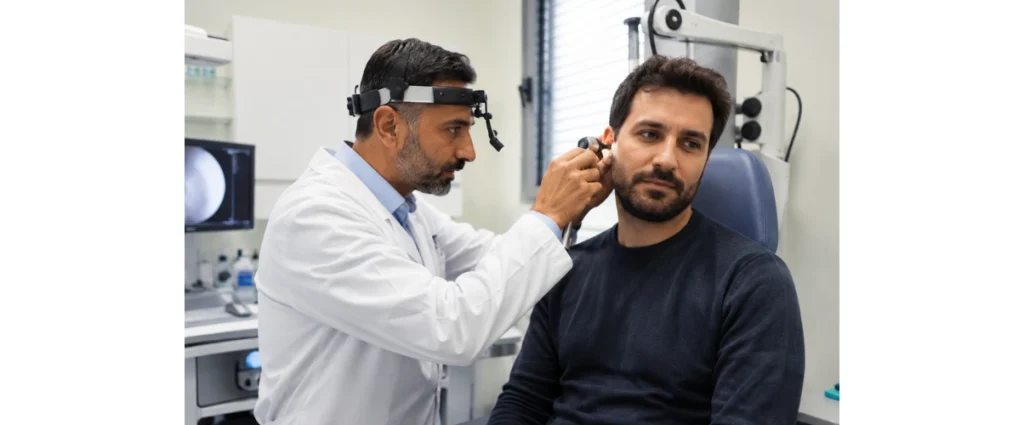
Ear Examination: The doctor examines the ear canal and eardrum using an otoscope or microscope to look for wax, infection, fluid, or structural problems.
Hearing Tests: A proper hearing test in Jayanagar may include one or more of the following, depending on the individual case:
- Pure-tone audiometry, to measure hearing thresholds across frequencies
- Speech audiometry, to assess speech understanding
- Tympanometry, to evaluate middle-ear function
- Otoacoustic emissions (OAE) testing
- Auditory brainstem response (ABR) testing, in selected cases
- Additional investigations depending on symptoms and examination findings
Not every patient needs every test — the specific combination depends on age, symptoms, suspected cause, and clinical findings during examination.
Hearing Loss Treatment Options
Effective hearing loss treatment in Jayanagar depends on the underlying cause, type, severity, duration, and overall ear health of the individual patient.
Earwax Removal: Professionally assessed earwax blockage can be safely removed using appropriate clinical methods. Do not insert cotton buds, pins, earbuds, or other objects deep into the ear canal, as this can push wax further in or injure the ear canal and eardrum.
Treatment for Ear Infections: Management depends on whether the infection involves the outer or middle ear, and whether it is bacterial, viral, or linked to another underlying condition. Specific medicines should only be recommended after clinical evaluation.
Treatment for Middle-Ear Problems: Depending on the diagnosis, some patients may need medical treatment, a period of observation, or a procedure to address fluid, eardrum, or middle-ear bone issues.
Hearing Aids: Hearing aids amplify sound and can benefit many people with sensorineural hearing loss, particularly age-related hearing loss. Suitability depends on a professional hearing assessment, and outcomes depend heavily on correct fitting and regular follow-up.
Surgery: Selected structural or middle-ear conditions — such as chronic infections, eardrum perforation, or otosclerosis — may be treated surgically. Surgery is not appropriate for every type of hearing loss and is considered only after thorough evaluation.
Cochlear Implants: A cochlear implant is an electronic device that can help selected individuals with severe-to-profound sensorineural hearing loss who do not gain sufficient benefit from hearing aids. Unlike a hearing aid, which amplifies sound, a cochlear implant bypasses damaged parts of the inner ear to stimulate the hearing nerve directly. Candidacy is determined through comprehensive audiological and medical evaluation, and cochlear implants are not suitable for every type or degree of hearing loss.
Hearing Loss Treatment in Bangalore: What to Look For
Adults searching for hearing loss treatment Bangalore should focus on finding the right diagnosis rather than choosing care based only on location or online claims. Before proceeding with any treatment, consider:
- A proper ENT evaluation
- A thorough hearing assessment
- Appropriate diagnostic testing based on your symptoms
- Experience in managing a range of hearing disorders
- Availability of hearing rehabilitation options, including hearing aids and implant evaluation
- Clear plans for follow-up care
- An honest discussion of whether surgical or non-surgical treatment is more suitable
For residents of Jayanagar and surrounding neighbourhoods, accessing this kind of thorough evaluation locally can make follow-up visits and ongoing care more convenient.
How to Choose an ENT Specialist in Jayanagar
When looking for the Best ENT Surgeon in Jayanagar or an ENT doctor near Jayanagar, patients should consider a few practical factors rather than relying on marketing claims alone:
- Relevant ENT qualifications and clinical experience
- Access to on-site or referral hearing assessment facilities
- A structured approach to diagnosis rather than assumption-based treatment
- Personalised treatment planning based on test results
- Clear communication about proposed treatment and its limitations
- Availability of proper follow-up care after treatment or surgery
Whether you are looking for a Best ENT Hospital in Jayanagar or an individual hearing loss specialist in Jayanagar, the priority should always be accurate diagnosis and a treatment plan suited to your specific type and cause of hearing loss — no single doctor or clinic can be objectively labelled “best” for every patient.
About Dr. Rohit Udaya Prasad and the Clinic
Dr. Rohit Udaya Prasad practises at Dr Rohit’s Centre for ENT & Cochlear Implant, located in 7th Block, Jayanagar, Bengaluru, Karnataka. The clinic focuses on ENT care, ear surgery, hearing care, and evaluation and treatment related to cochlear implants. Patients visiting the clinic can expect a clinical evaluation process that includes history-taking, ear examination, and appropriate hearing assessment to guide treatment decisions.
Conclusion
Adult hearing loss can stem from many different causes, ranging from simple earwax blockage to more complex inner-ear or nerve-related conditions. Early assessment helps identify the underlying problem so that appropriate care can begin without unnecessary delay, and sudden hearing loss in particular calls for prompt medical attention rather than a wait-and-watch approach. Because the right approach to hearing loss treatment in Jayanagar depends on the specific type, cause, and severity of hearing loss, a proper ENT evaluation is the most reliable starting point.
If you or a family member is experiencing persistent, progressively worsening, or sudden hearing changes, consider scheduling an evaluation with Dr. Rohit Udaya Prasad at Dr Rohit’s Centre for ENT & Cochlear Implant in 7th Block, Jayanagar, Bengaluru, for a thorough assessment and guidance on suitable next steps. Outcomes vary from patient to patient, and any treatment plan will depend on your individual evaluation.
Frequently Asked Questions
- Why am I losing my hearing in one or both ears?
Hearing loss can result from earwax blockage, infection, fluid buildup, noise exposure, aging, or inner-ear and nerve conditions. One-sided hearing loss deserves particular attention, as it can sometimes indicate a more specific underlying cause that needs prompt ENT evaluation. - What are the most common causes of hearing loss in adults?
Common hearing loss causes include earwax buildup, ear infections, prolonged loud-noise exposure, age-related changes, eardrum or middle-ear problems, certain medications, and inner-ear or nerve conditions. The exact cause is confirmed through examination and hearing tests. - Can hearing loss be treated or reversed?
It depends on the cause. Conductive issues like earwax or fluid are often treatable. Sensorineural hearing loss, such as age-related or noise-induced loss, is usually managed with hearing aids or other rehabilitation rather than reversed. - When should I see an ENT doctor for hearing loss?
See an ENT doctor if hearing difficulty is persistent, affects one ear, follows an injury or loud noise, or comes with pain, discharge, ringing, or dizziness. Sudden hearing loss should be evaluated immediately rather than delayed. - What happens during a hearing test?
A hearing test in Jayanagar typically includes an ear examination followed by assessments such as pure-tone audiometry, speech audiometry, or tympanometry. The specific tests chosen depend on your age, symptoms, and examination findings. - Is sudden hearing loss an emergency?
Sudden hearing loss, especially in one ear, should be treated as urgent. Sudden hearing loss treatment outcomes can depend on how quickly the underlying cause is evaluated, so prompt medical assessment is strongly advised rather than waiting to see if it resolves. - Can age-related hearing loss be prevented?
Age-related hearing loss cannot always be fully prevented, but protecting ears from loud noise, managing health conditions, and avoiding unnecessary ototoxic medications may help preserve hearing. Regular hearing checks help track changes early. - Are hearing aids suitable for every type of hearing loss?
No. Hearing aids are commonly used for sensorineural hearing loss but are not appropriate for every case, especially where a structural or medically treatable problem is present. Suitability is determined after a proper hearing evaluation. - Where can I get hearing loss treatment in Jayanagar?
Adults in the area can seek hearing loss treatment in Jayanagar at ENT clinics offering hearing assessment and cochlear implant evaluation, such as Dr Rohit’s Centre for ENT & Cochlear Implant in 7th Block, Jayanagar, Bengaluru. - Which doctor should I see for hearing loss in Bengaluru?
Look for an ENT specialist in Jayanagar or elsewhere in Bengaluru with experience in hearing disorders and access to proper diagnostic testing. Dr. Rohit Udaya Prasad at Dr Rohit’s Centre for ENT & Cochlear Implant is one option for adults seeking ENT and hearing evaluation in the Jayanagar area.